Opening the Source
 engraving★
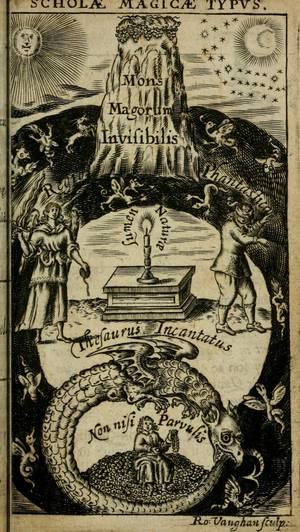
An elaborate allegorical engraving titled 'SCHOLÆ MAGICÆ TYPVS' (Type of the School of Magic). It features a central 'Invisible Mountain of the Magi' (Mons Magorum Invisibilis) topped with a cloud. Below the mountain, an angel on the left and a blindfolded man on the right flank an altar with a single candle labeled 'Lumen Naturæ' (Light of Nature). Surrounding this is an arch labeled 'Regio Phantastica' populated by monstrous creatures. At the bottom, a large dragon or Ouroboros encircles a child sitting on a heap of coins, with the legend 'Non nisi Parvulis' (Only for the little ones). Celestial bodies (Sun, Moon, and stars) appear in the upper corners.
Lumen de Lumine, or A New Magicall Light
 portrait★
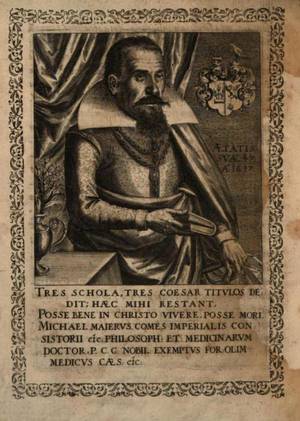
Engraved portrait of the alchemist and physician Michael Maier at age 49. He is depicted in a ruff and doublet, holding a book, with his coat of arms in the background. The entire composition is enclosed within a decorative floral border and includes a Latin inscription at the bottom.
Symbola aureae mensae duodecim nationum
 engraving★
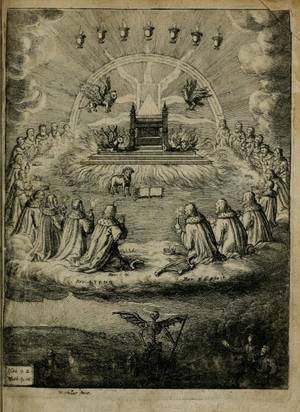
A complex 17th-century religious engraving by Wenceslaus Hollar. The upper register depicts a celestial scene from the Book of Revelation: the throne of God surrounded by a rainbow and seven burning lamps (representing the Seven Spirits of God). Four living creatures (lion, eagle, man, and ox) flank the throne. Below it, the Lamb of God stands near an open book, while twenty-four elders kneel in a circle, casting their crowns and offering prayers. The lower register presents a stark contrast, showing a winged skeletal figure of Death with a scythe presiding over a dark landscape where people dwell in shadow, illustrating the prophecies cited from Isaiah and Matthew regarding those who sit in darkness seeing a great light.
Aurora, or The Day-Spring
 engraving★
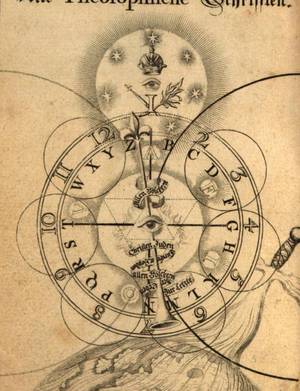
A complex theosophical emblem or diagram serving as the frontispiece/title illustration for Jacob Böhme's works. It consists of concentric circles containing numbers and an alphabet arranged like a clock face. At the center is the Eye of Providence within a triangle, with scrolls of text. Above the central wheel is a second eye within a radiant star-filled circle, topped by a crown. The composition is flanked by a lily on the left and a sword on the right. At the bottom, a trumpet extends from the central axis toward a representation of the globe (Earth).
Jakob Böhme: Alle Theosophische Wercken (Complete Works)
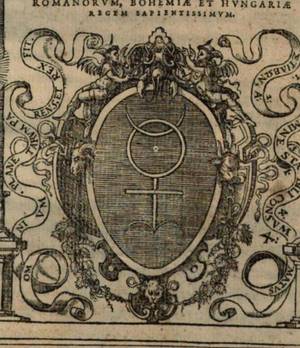 emblem★
The 'Hieroglyphic Monad' (Monas Hieroglyphica) symbol, a composite glyph designed by John Dee representing the unity of the cosmos through alchemical and astrological components (Sun, Moon, elements, and Aries). It is enclosed in an oval frame surrounded by Latin scrolls.
The Hieroglyphic Monad (1564 Antwerp)
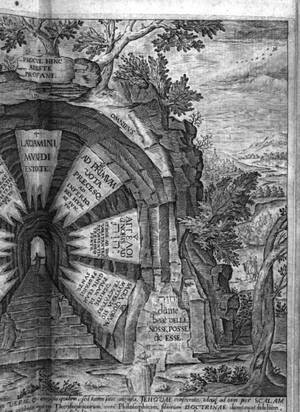 engraving★
A complex allegorical emblem depicting the entrance to a cave or portal of wisdom, titled 'The Gate of Amphitheatrum'. Seven rays of text (divine laws) emanate from the opening. On the right, a landscape with a town, figures, and birds. In the foreground, a figure enters the long perspective of a hall. The scene is rich with hermetic and alchemical symbolism.
Amphitheatre of Eternal Wisdom (1609)
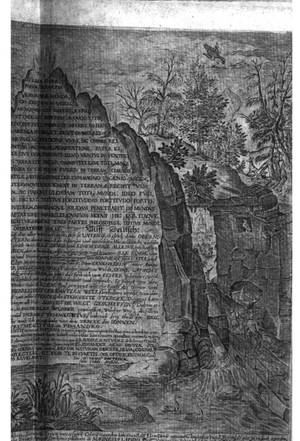 engraving★
A complex alchemical landscape engraving. On the left, a large rock face is inscribed with the Latin text of the 'Emerald Tablet' of Hermes Trismegistus, followed by a German translation and a quote from the 'Pimander'. The landscape features a river with swans, a crab on the shore, a phoenix/eagle flying towards the sun, and small figures of horsemen and travelers in the background.
Amphitheatre of Eternal Wisdom (1609)
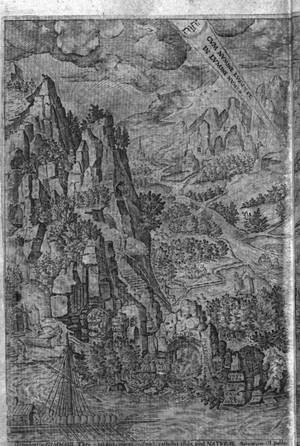 engraving★
The 'Mountain of the Adepts' or 'Gymnasium of Nature', a complex allegorical engraving from Heinrich Khunrath's 'Amphitheatrum Sapientiae Aeternae'. It depicts a landscape with a winding path leading to a hidden sanctuary (Precatio) inside a mountain, representing the difficult journey toward alchemical and spiritual enlightenment. The scene includes seekers at various stages of the path, a river with a boat, and a divine ray of light descending from the Tetragrammaton.
Amphitheatre of Eternal Wisdom (1609)
 engraving★
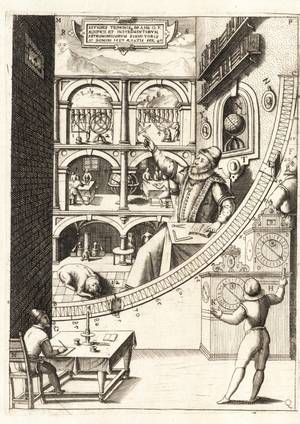
An elaborate engraving of Tycho Brahe seated at a desk, gesturing toward a large mural quadrant (a brass arc mounted on a wall) used for determining the positions of stars. The background depicts the interior of his observatory, Uraniborg, with multiple levels showing assistants at work with various scientific instruments, clocks, and chemical apparatus. The foreground shows assistants recording observations and a dog sleeping at Tycho's feet.
Instruments of the Restored Astronomy
 engraving★
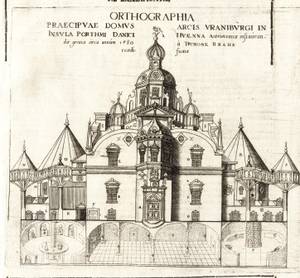
Architectural elevation and section of Uraniborg, Tycho Brahe's observatory
Instruments of the Restored Astronomy
 diagram★
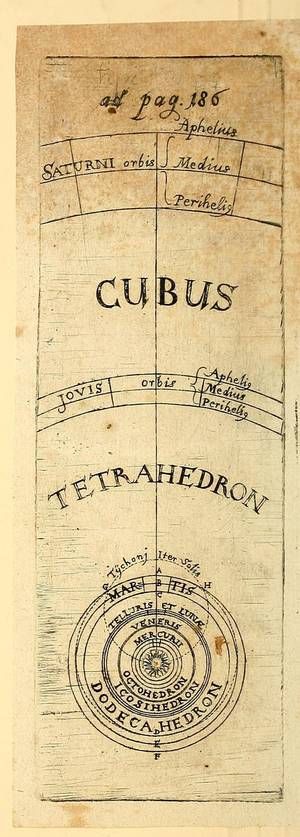
A scientific diagram showing the nested spheres of planetary orbits (Saturn, Jupiter, Mars, Earth, Venus, Mercury) separated by the five Platonic solids (Cube, Tetrahedron, Dodecahedron, Icosahedron, Octahedron). The diagram includes labels for aphelion (Aphelis) and perihelion (Perihelis) points and references the Tychonic system.
Harmony of the World (with Mysterium cosmographicum)
 diagram★
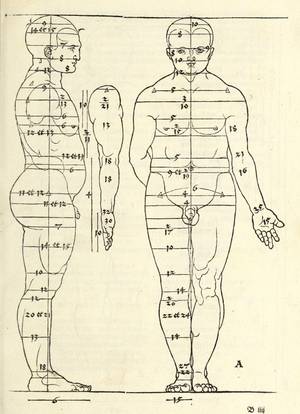
Anatomical woodcut diagrams showing the proportions of the human male body in profile and frontal views, labeled with numerical measurements and symbols.
On the Symmetry of Human Bodies
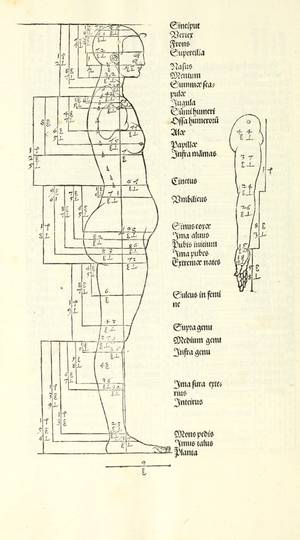 diagram★
A Renaissance anatomical diagram of a female body in profile and a separate arm, annotated with a complex system of proportional measurements and Latin labels for various body parts.
On the Symmetry of Human Bodies
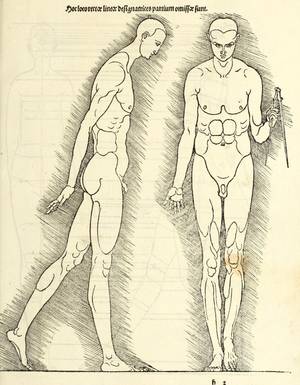 woodcut★
Two woodcut anatomical studies of male figures illustrating human proportions. The figure on the left is depicted in profile, walking or standing with legs apart. The figure on the right is shown in a frontal view, holding a large pair of dividers (calipers) in its left hand. The figures are rendered with precise line work and hatching to define musculature and form.
On the Symmetry of Human Bodies
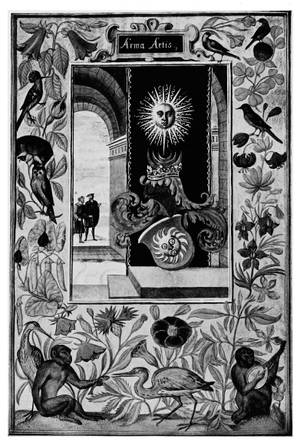 emblem★
The 'Arma Artis' (Arms of the Art) alchemical emblem from the Splendor Solis manuscript. The central image depicts a heraldic shield bearing a sun with a human face, topped by a helmet, a crescent moon crown, and a radiant sun above. In the background, two men in period clothing are seen through an archway. The entire scene is enclosed within a lavishly decorated border containing detailed botanical illustrations and various animals, including an owl, a heron, and monkeys—one of which is playing a lute.
Splendor Solis: The Splendour of the Sun
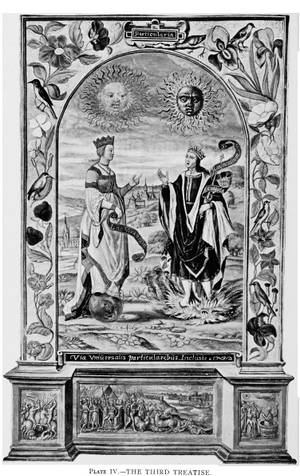 emblem★
A complex alchemical emblem from the Splendor Solis. The central image shows a Queen on the left standing on a moon-faced globe and a King on the right standing within a basin of fire. They are framed by an architectural arch under two celestial suns. The Queen holds a scroll reading 'Lac Virginum' (Virgin's Milk), while the King holds one reading 'Masculum Coagula' (Coagulate the Male). The entire scene is surrounded by an ornate border of flowers and birds. At the base, a predella features three vignettes of historical figures, including Alexander the Great.
Splendor Solis: The Splendour of the Sun
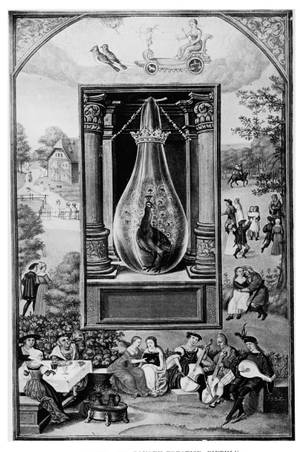 emblem★
A reproduction of Plate 16 from the 1582 manuscript 'Splendor Solis'. The central emblem depicts a peacock inside a glass flask (cucurbit) crowned with gold, situated between two ornate architectural columns. Above the flask, a celestial chariot pulled by two birds carries the goddess Venus and Cupid. The scene is framed by elaborate genre paintings: on the left, a rural scene with a farmhouse and travelers; on the right, dancers and a rider; and at the bottom, a festive banquet with musicians playing the lute and viola da gamba. The date '1582' is inscribed in the lower corners of the inner frame.
Splendor Solis: The Splendour of the Sun
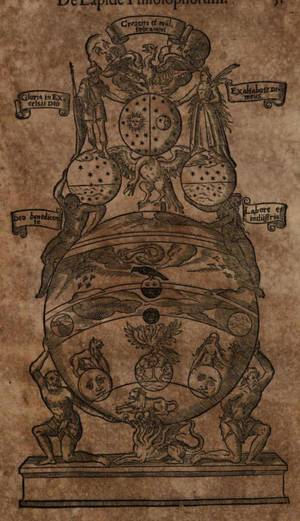 emblem★
A complex alchemical emblem representing the stages of the Great Work. It features a large central sphere supported by two figures, containing symbolic imagery such as a crow (Nigredo), a white bird (Albedo), a phoenix (Rubedo), the sun and moon, and lions. Above the sphere, several celestial globes and figures of a king and queen represent alchemical principles. The entire structure is adorned with Latin banners and rests on a pedestal featuring a multi-headed dragon.
Alchymia: Comprehensive Treatise on Alchemy
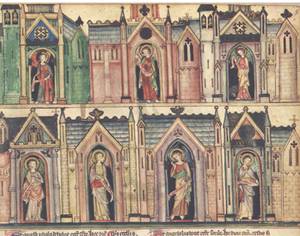 decorative★
The seven angels of the churches of Asia standing in Gothic architectural niches, holding scrolls with the names of the churches: Ephesus, Smyrna, Pergamum, Thyatira, Sardis, Philadelphia, and Laodicea.
Cloisters Apocalypse - 14th Century Manuscript Facsimile
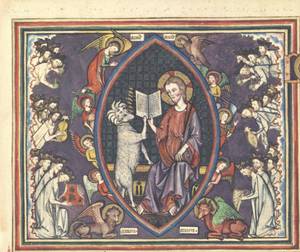 woodcut★
A large rectangular miniature depicting Christ in Majesty within a blue mandorla, seated on a throne and holding an open book. A white lamb with seven horns and seven eyes (Agnus Dei) climbs onto his lap. The mandorla is surrounded by the four winged creatures (Tetramorph) and the twenty-four elders holding harps and vials. Small labels with 'amẽ' and 'amen' are placed around the central figure.
Cloisters Apocalypse - 14th Century Manuscript Facsimile
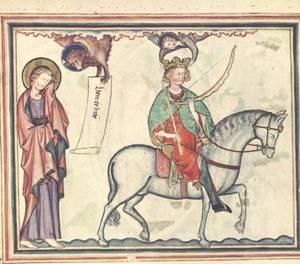 ★
★A large rectangular framed miniature illustrating Revelation 6:1-2. On the left, John the Evangelist stands in robes, holding a book and gesturing towards the vision. Above him, the first living creature (a winged lion) emerges from a cloud, holding a scroll that reads 'Ueni et uide' (Come and see). In the center, the first Horseman of the Apocalypse rides a white horse; he is crowned by an angel leaning from heaven and holds a bow in his left hand. The background is a plain parchment with a wavy ground line representing the earth.
Cloisters Apocalypse - 14th Century Manuscript Facsimile
 diagram★
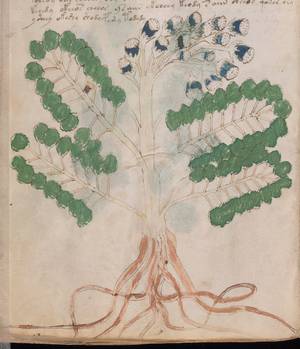
A full-page botanical illustration featuring a plant with several large compound leaves consisting of many small, rounded green leaflets. The central stem branches upward into a cluster of blue and white cup-shaped flowers or seed heads. The base of the plant shows a detailed, intertwined root system in a reddish-brown hue.
Voynich Manuscript - High Resolution Scans
 diagram★
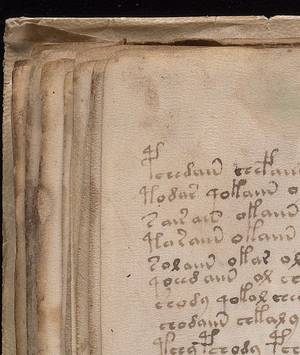
Large botanical illustration of an unidentified plant. The top right features a large, complex flower head with concentric circles of blue and green petals and a central disk. The flower sits on a textured, funnel-shaped red receptacle with green vertical markings. The stem is thin and pale, leading to large, serrated green leaves and several brown, bulbous, radish-like roots. A smaller, similar plant structure with leaves and roots is shown on the bottom left.
Voynich Manuscript - High Resolution Scans
 diagram★
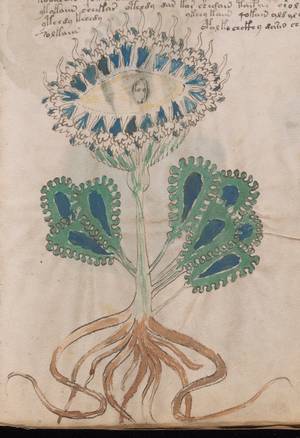
A botanical illustration of an unidentified plant. The central feature is a large, circular bloom with flame-like rays around the edge and a prominent central motif resembling a human eye, which contains three small characters. Below the flower are large, green, deeply lobed leaves with blue semi-circular centers. The root system consists of several long, tapering, intertwined brown roots.
Voynich Manuscript - High Resolution Scans
Page 1 of 49